Edge lift is the first warning
When a mounted board starts lifting at the corners or along the sides, the bond has already begun to fail. This happens often on boards that were stored in a warm room, handled too soon after mounting, or exposed to humidity in coastal areas. In Johannesburg winter dry air can hide the problem for a while, then the first warm spell shows it up fast.
If the edge lift is small and localised, you may still save the piece. Once the lift runs along a full edge or the board makes a hollow sound when pressed, remounting is the safer call. Trying to patch it with tape or extra adhesive usually leaves marks and creates more work later.
- Check all four corners under bright light
- Press gently near the edge to feel for movement
- Look for dust lines where the board has opened up
Bubbles, ripples and trapped moisture mean trouble
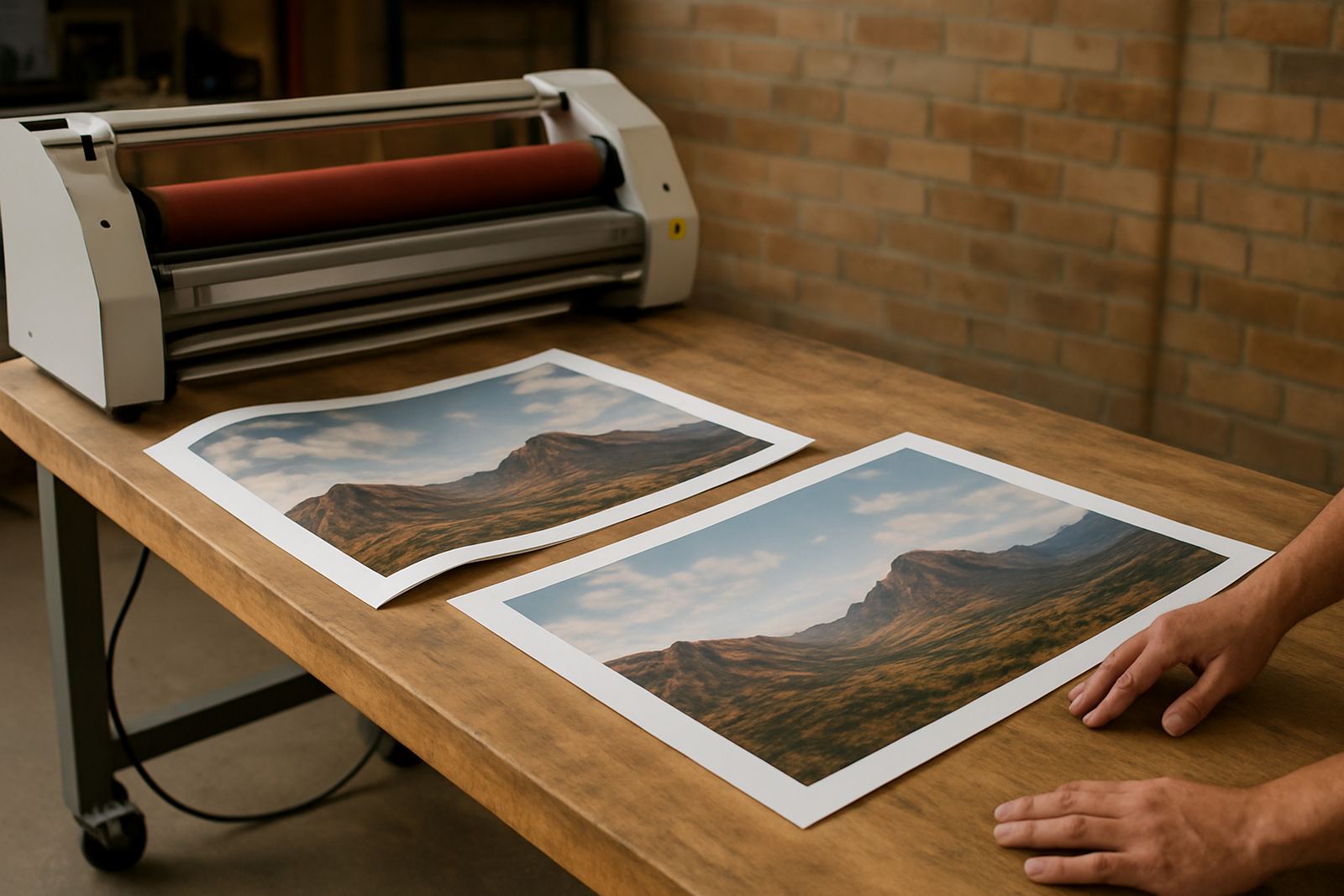
Surface bubbles are not only a cosmetic issue. They point to trapped air, moisture or uneven pressure during the original mounting process. A few tiny bubbles may be acceptable on a working sample, but on presentation pieces they draw the eye immediately. Once the surface starts rippling, the board will not sit flat on a wall and the finish loses that neat, professional look clients pay for.
In print shops around Kya Sand and Randburg, this shows up most on jobs that were moved quickly from cutting to mounting. In summer, a board can pick up moisture from a cool storeroom then expand under heat, which leaves a wavy finish by the next day. If the ripples are across the centre of the board, not just near the edges, a remount is normally the right decision.
- Bubbles near the centre often mean poor pressure or dust on the surface
- Ripples after overnight storage can point to humidity changes
- Visible waviness under side light is hard to hide
Faded print colours make the mounting look worse
Sometimes the mount itself is still sound, but the print no longer holds its colour well enough for the job. A faded poster, artwork or promotional panel can look even older once it is mounted onto a fresh board because the contrast is so clear. If the print has shifted in colour, yellowed, or lost density, remounting onto a new board is often the chance to redo the whole presentation properly.
This matters in reception areas, gallery pieces and sales boards where first impressions count. A client may not say the colour looks off, but they will notice that the work feels flat. If you are already taking the piece off the old board, it is worth checking whether the print should be remade as well. There is no point mounting a tired print twice.
- Check whites for yellowing
- Compare the board under daylight and indoor light
- Look for fading on edges that have seen sun through a window
When warping means the board cannot be trusted
A board that has warped has usually had one too many heat cycles, a moisture issue, or uneven storage pressure. Once the panel no longer sits flat, the mounted print will reflect that movement. Frames may not cover the problem either, because a bowed board can push the print out of alignment and create a poor fit on the wall.
For businesses in Pretoria and the East Rand, transport is often part of the problem. Boards standing in a bakkie for a long drive can flex in the sun, especially if they are left near a canopy or window. If the board has a permanent bend, not just a slight curve, remounting on a fresh, stable substrate is the practical fix.
- Lay the board on a flat floor and check for gaps underneath
- Rotate it 90 degrees to see if the curve changes
- Watch for mounting work that lifts after transport
Presentation deadlines are a good time to replace older mounts
Not every remount is about failure. Sometimes the better reason is simply that the piece is going out again for a new client meeting, trade show or showroom display. A mounted board that still looks acceptable in storage may not be suitable for a fresh presentation if the corners are scuffed, the surface has picked up handling marks or old adhesive stains are showing through. In those cases, remounting is part of keeping the work saleable.
For example, a signage shop in Midrand may have a board that was used for a property launch in 2022. The client now wants the same concept reused for a new site in Sandton. If the old mount has slight lift, ink wear and a few marks from repeated transport, remounting onto a clean board will save time later and avoid an awkward reprint discussion.
- Check for scuffs from storage racks
- Inspect the reverse side for glue bleed or board damage
- Remount before a trade show rather than after a complaint
How to decide between repair and full remount
The simplest test is this: if the fault affects flatness, finish or the life of the piece, remount it. If the issue is minor and not visible to a client, a repair may be enough. The more valuable or visible the work, the lower the tolerance should be for flaws. A small lift on a sample board might be tolerable, but on a mounted artwork or sales display it can look untidy very quickly.
A proper inspection should include the board, the print, the adhesive bond and the storage conditions. That is why pre-purchase inspections and on-site breakdown checks are useful for teams handling larger laminating and mounting equipment. If your current setup is not keeping pressure even or the heat system is inconsistent, the same defects will keep coming back. In that case it may be time for servicing, not just another repair job.
At Laminator in Kya Sand, we work with print shops, designers and artists across Johannesburg, Pretoria, Midrand and beyond. If you need help working out whether a mounted board should be redone, a practical inspection is the best starting point, because a poor mount usually shows a pattern once you know where to look.